
Casinos that accept Bitcoin in the UK: what to check
 Available in GB
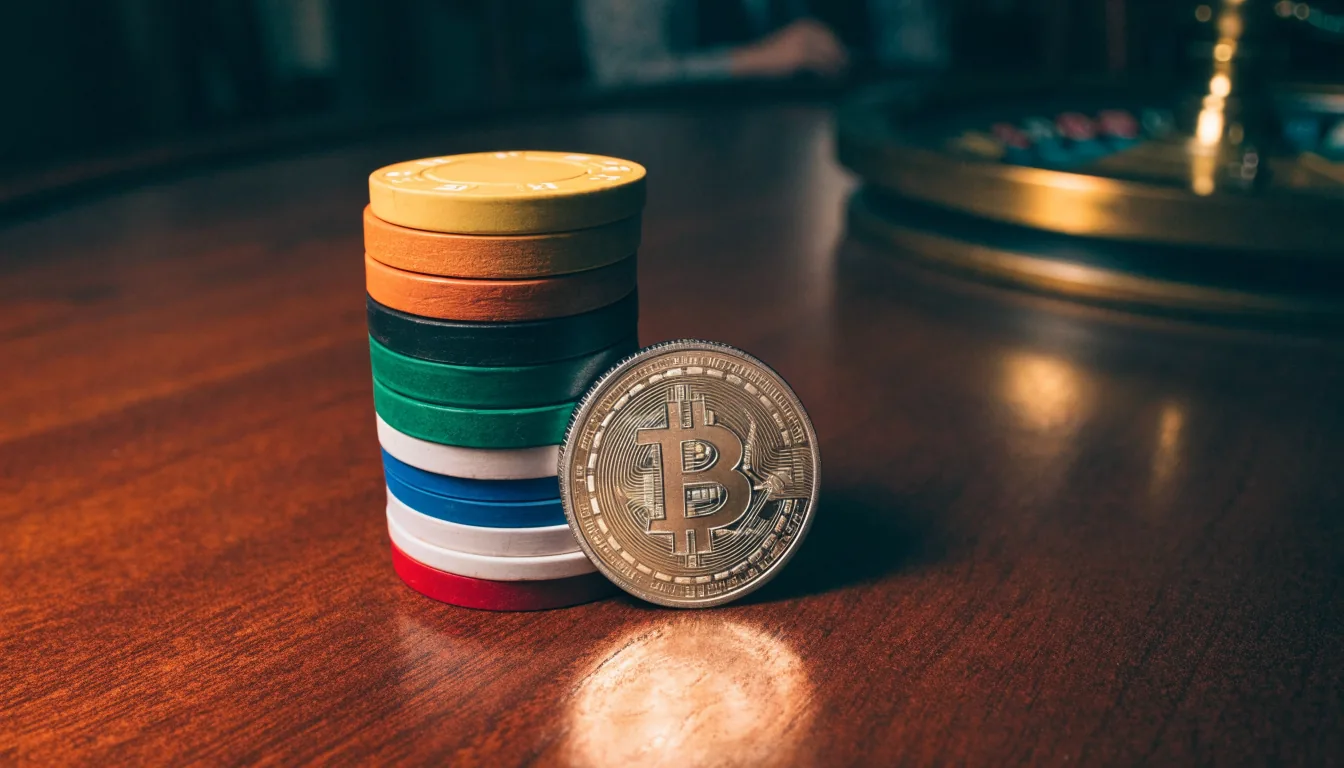
A casino’s general cryptocurrency wording does not confirm Bitcoin availability for a UK account or explain the conditions attached to deposits and payouts.
Bitcoin in the UK Casino Cashier: What the Evidence Can Establish
Bitcoin has become a familiar label in online gambling, but familiarity is not the same as a confirmed payment option. A casino page may discuss cryptocurrency, a review may describe a site as accepting digital currencies, and a cashier may display a set of payment symbols. Those statements do not necessarily establish that Bitcoin is available for a particular UK account. The distinction matters: a broad category can sound like a specific promise while saying very little about the transaction itself.
A specialist casino-payment review describes the websites it examined as mentioning Visa, Mastercard, bank transfer, e-wallets and several cryptocurrencies. That is a snapshot of the kinds of payment language appearing across those sites, not a Bitcoin directory. The description does not connect each cryptocurrency to an individual casino, nor does it confirm that Bitcoin is among the currencies accepted at any named operator. It would be a leap to turn “several cryptocurrencies” into a list of UK Bitcoin casinos.
Casinos That Accept USDC in the UK: What to Check
The wording is easy to blur. “Crypto-friendly” might refer to a general policy, a site’s international offering, or a payment feature discussed in promotional material. “Cryptocurrency accepted” is still a category, not a currency-by-currency statement. Bitcoin, though the best-known name in that category, cannot be silently substituted for it. A reference to crypto is not, by itself, evidence of Bitcoin support.
There is a further difference between a casino being associated with Bitcoin and taking it as a payment method. A page might mention digital assets in an article, a promotion, a brand description or a discussion of the wider gambling market. None of those uses demonstrates that Bitcoin can fund a gambling account. Nor does a mention of one cryptocurrency establish that another is accepted. The category may contain many assets; the cashier needs to identify the particular one.
This is why claims about the “best Bitcoin casinos” are especially difficult to support without specific, attributable payment information. A ranking implies that the casinos being compared meet a shared condition: in this case, that they accept Bitcoin. If the underlying descriptions only refer to cryptocurrencies collectively, the defining condition has not been established. A polished table can make the gap look smaller. It cannot close it.
Casinos that accept Boku in the UK: payment guide
The same caution applies to phrases such as “Bitcoin casino” and “Bitcoin online casino”. They are useful shorthand in conversation, but they can describe different things: a site that accepts Bitcoin, a casino-themed service built around digital currency, or simply a page discussing Bitcoin and gambling. In a UK setting, the phrase alone does not establish the payment arrangement or the operator’s status. Labels travel more easily than the details behind them.
A careful account of what is known therefore remains narrow. The specialist review’s description supports the statement that the websites it examined mention conventional payment types, e-wallets and multiple cryptocurrencies. It does not support naming particular operators as Bitcoin-accepting casinos. It also does not show that every site in the group offers the same payment menu, or that any listed method applies to every customer. Those would be separate claims, requiring separate evidence.
This is not an argument that Bitcoin cannot be used at a UK-facing casino. It is a distinction between possibility and confirmation. Without a named operator linked to Bitcoin as an accepted method, a reader cannot infer a dependable list from a general reference to cryptocurrencies. A category is not a cashier entry.
The distinction is particularly important because payment language often serves more than one purpose. A general review may summarise a site’s advertised methods, while an operator’s public pages may describe services across several markets. Neither description necessarily states what a UK customer can use. A claim about availability needs a clear subject and a clear method: which casino, which currency, and whether Bitcoin is actually presented as a payment option. Without that connection, the claim remains broader than its evidence.
For the phrase “casinos that accept Bitcoin in the UK”, the defensible answer is therefore not a named or ranked selection. That boundary is modest, but it keeps a general mention from becoming a false endorsement. In payment matters, precision is less glamorous than a list. More useful, too.
Do
- Check the operator’s actual cashier for current Bitcoin support.
- Review the specific terms and conditions for a payment method.
- Verify the account’s denomination and supported currency.
Don’t
- Assume a general mention of “crypto” implies Bitcoin availability.
- Treat a site’s marketing labels as confirmed payment evidence.
- Use a single “best” label to compare different payment setups.
Recommended online casinos
- BeOnBetBonus: 100% up to €500 + 100 FS · Payout speed: 1-3 business days
- WinBeastBonus: €5000 + 500 FS + €650 Freebet · Payout speed: 1-3 business days
- BritsinoBonus: Welcome Package – Get your £2,200 + 2,000 FS · Payout speed: 1-3 business days
- AmunbetBonus: Join now and get 450% up to 2,700 GBP + 450 FS · Payout speed: 1-3 business days
- x3betBonus: Welcome Pack 100% Up to £1.000 + 200 Free Spins · Payout speed: 1-3 business days
- NightLuckBonus: Welcome Pack + 805% Up To 6400€ + 280 FS · Payout speed: 1-3 business days
How to Judge a Bitcoin Casino Without a Rankings List
A ranking can make a payment method look settled: a casino appears under a Bitcoin label, and the label begins to stand in for evidence. It should not. Payment arrangements change, and a broad description of a site does not establish that Bitcoin is currently offered to customers in the UK. The useful question is narrower: what does the casino’s own cashier say, and what do its terms say about the method?
That approach is less dramatic than a league table, but more dependable. A name on a list is not a payment option. Nor does the word “crypto” settle which currencies are accepted, whether the option applies to UK customers, or what conditions accompany it. Those details belong to the operator’s current payment information, not to a general label repeated elsewhere.
A careful assessment begins with the actual method, not the category. If a cashier lists Bitcoin, the accompanying terms should make clear how it is used and whether the stated conditions fit the intended transaction. If the information is vague, the listing is not enough to support a confident claim. A casino may still be worth examining, but it has not earned a place on a factual Bitcoin list merely by sounding technologically current.
The same discipline applies to familiar payment brands. A specialist review of casino payment pages lists Visa and Mastercard, but that does not establish current availability for every UK customer or every card product. Those details need checking in the cashier. A payment logo can be a convenient shorthand; it is not a promise about eligibility. The distinction matters particularly in Britain, where credit-card payments for gambling are prohibited at UK-licensed casinos. A brand name alone cannot tell a customer which card product is permitted.
Casinos That Accept Litecoin in the UK: What to Check
Currency is another detail that can make a seemingly clear option less clear in practice. A specialist review reports that the casino pages it examined support GBP, but the account currency still needs confirmation before a first transaction. If the account is set to a different currency, conversion may enter the process. That is not a judgement about Bitcoin itself; it is a reminder that a payment method and the currency in which the casino keeps an account are separate parts of the arrangement.
A sound comparison therefore has little use for a single “best” label. It can instead ask whether the casino’s own information identifies the payment method precisely, whether the conditions are intelligible, and whether the UK-facing cashier reflects the claim being made. Clear answers make a site easier to assess. Missing or contradictory details make a ranking less meaningful, not more.
This also keeps the language honest. “Bitcoin casino” may describe a site’s image, a search category, or a payment option that is no longer available. Those are not interchangeable descriptions. A Bitcoin casino site in the meaningful sense is one whose current cashier and terms establish the relevant support for the customer concerned. Without that confirmation, the phrase is only a heading.
The reader is not served by a long list assembled from old logos and broad descriptions. A shorter assessment, grounded in the live payment information, says more. It respects the difference between a casino that mentions cryptocurrency and one that actually presents Bitcoin as an available method under clear conditions. No glitter required.
A payment logo on a homepage is a statement of possibility, but the cashier is the practical record of what is actually available to a signed-in account.
Online Casino Payments and the Cashier Check
A payment logo on a casino’s homepage is a statement of possibility, not proof that the method can be used for every deposit. The cashier is the more practical record: it shows the routes presented to a signed-in account, often after the operator has considered location, account status and the transaction being attempted. A method mentioned in general site copy may not appear there at all.
That distinction matters when a casino is described as accepting Bitcoin. The label alone does not establish that a Bitcoin deposit is available to a UK account, or that it can be used for a particular transaction. A list of payment brands and a working cashier route are different kinds of evidence. One is an invitation; the other is an available choice.
Payment compatibility can also be specific to the account. A method displayed on an operator’s public information page may be unavailable because of the account’s status or the conditions attached to that transaction. Deposit limits can differ by payment method and account status, and a cashier may show a different permitted amount from a general payment guide. The numbers are not interchangeable.
Minimum deposits need the same care. A specialist casino review reports that minimums can begin within a stated range, with the amount depending on the method selected; that is a description from a review, not a fixed rule for every operator or account. The cashier’s own figure is the relevant one at the point of deposit. A generic figure can age quickly, or simply fail to describe the route in use.
Casinos That Accept Dogecoin in the UK: What to Check
The payment method must also fit the type of transaction. UK remote gambling operators cannot accept credit-card payments for gambling, including credit-card funding routed through a money service business. Wallets cannot be used where they permit credit-card funds to be spent on gambling. A brand name, therefore, does not settle the question: the funding source and the operator’s actual configuration matter. Debit cards are a different category, but their appearance on a site does not guarantee that every card product or account will be eligible.
There is a second distinction between seeing an option and being able to complete the deposit. Operators must verify a customer’s age before allowing funds to be deposited into a gambling account. A cashier route can therefore be visible before an account is ready to use it. The interface is not a promise that every step has already been cleared.
For an online casino that advertises Bitcoin, the same test applies as for any payment method: the UK-facing cashier needs to identify the route, state its conditions and permit the intended transaction. If those details are absent, the broad label should not be treated as confirmation. Nor does a payment option establish that the operator is authorised to serve the British market. Remote gambling licensees selling into that market must hold the relevant Gambling Commission licence.
The cashier is mundane by design. It turns a marketing claim into a specific transaction, or exposes the distance between them. That distance is the useful part.
Bonuses, Deposits and Payment-Method Conditions
A casino promotion is not simply an extra attached to an account. Its terms can make the payment method part of the offer: a deposit may be accepted while the promotion is not. That distinction matters when a bonus is the reason for choosing a particular route. The cashier answers whether a payment can be made; the promotion terms answer whether that payment counts towards an offer.
Attention A deposit method being accepted does not automatically mean it is eligible for specific bonus promotions.
Payment restrictions are not always presented prominently beside the headline. They may sit in the full terms, under eligibility or excluded methods, and can apply to one promotion rather than every offer at the casino. A deposit through a named wallet, for instance, might be accepted but left out of bonus eligibility. The result is not a failed transaction. It is a deposit without the advertised extra.
A specialist casino review has reported that PayPal may be excluded from bonus eligibility, despite its appeal as a payment option. That is a report about a possible condition, not a rule shared by every casino or promotion. The relevant terms are those attached to the live offer, not a general description of a payment brand.
The same caution applies to Skrill and Neteller. A specialist casino review has described them as available at some sites and often excluded from promotions. The wording matters: availability at a casino does not establish eligibility for a particular bonus. Nor does a restriction on one offer prove that every promotion excludes the same method. Terms can differ, and they can change.
Bitcoin-branded offers require the same separation between payment language and promotion rules. A search for a Bitcoin casino no-deposit bonus does not establish that a particular casino offers one, or that a Bitcoin payment is relevant to it. A no-deposit promotion, by definition, is not an invitation to assume that a deposit method will unlock the offer. Its own conditions determine who qualifies and what must be done to claim or use it. No method should be treated as qualifying unless the current terms say so.
Casinos That Accept Monzo in the UK: Payment Facts
The small print can also define how the bonus is activated, which customers are eligible, and what restrictions apply to its use. Those are offer conditions, not features of Bitcoin itself. A payment label in a promotion title may describe the audience the offer is intended to attract; it is not proof that every payment associated with that label is accepted or qualifies.
This is where promotional language acquires its peculiar precision. A large headline may be easy to remember; an exclusion hidden in terms can decide whether the offer applies at all. There is no useful shortcut from “payment accepted” to “bonus eligible”. The two statements concern different decisions.
For anyone comparing a Bitcoin casino no-deposit offer with a deposit promotion, the distinction is especially plain: the former should be assessed by its own eligibility and claim conditions, while the latter may additionally specify which deposits count. Neither title settles the matter. The live promotion terms do.
Promotions are conditional by design. A payment method can be convenient for a transaction and still be unsuitable for a particular offer. Reading the terms as part of the offer, rather than as decoration beneath it, is the least dramatic way to avoid an unexpected separation between the deposit and the bonus.
Bitcoin Slots: Availability Is Not the Same as a Game Catalogue
The phrase “Bitcoin slots” can point to two different things: a casino’s payment language, or the games available to play. Those are not interchangeable. A site may discuss cryptocurrency in connection with its cashier without that telling anything about its slot catalogue. Conversely, a game catalogue says nothing by itself about how an account can be funded.
Distinction
Bitcoin is a payment method, while slots describe a game category; one does not guarantee the other.
A specialist review of casino websites describes payment options spanning Visa, Mastercard, bank transfers, e-wallets and several cryptocurrencies. That is a snapshot of payment terminology, not a directory of games. It does not establish that Bitcoin is accepted by every site mentioned, nor does it identify particular slots that can be played with Bitcoin. The distinction is less glamorous than a ranked list. It is also more useful.
Casino games are generally presented as titles in a lobby or catalogue, while payment methods appear in the cashier or payment information. When those two areas are blurred together, a phrase such as “Bitcoin casino” can start to sound like a special kind of game. It is not evidence of one. Bitcoin is a payment method; “slots” describes a game category. Putting the terms together does not show that a casino has a Bitcoin-branded slot, or that any particular game accepts a cryptocurrency stake.
The same caution applies to lists of Bitcoin casino sites, including lists described as the best or most trusted. A list title cannot make its entries comparable, and a label cannot show what a site currently offers. Nor does it establish the contents of each game lobby. Without named, verifiable titles, claims about the selection would be guesswork dressed as a catalogue.
There is a social history in the way these labels travel. Casinos have long organised play into familiar categories—slots, table games, live games—while payment systems sit behind the counter, as a matter of access rather than entertainment. Cryptocurrency has made the cashier itself a selling point in some descriptions. That shift can make a payment feature look like a genre, even though the two answer different questions: how money moves, and what people can play.
Casinos That Accept Debit Cards in the UK
For anyone comparing a casino’s games, the useful evidence is the game catalogue itself: titles and categories shown by the operator. For anyone assessing Bitcoin, the relevant evidence is separate and concerns payment support. Neither can stand in for the other. A page mentioning cryptocurrencies cannot establish which slot titles are available, and a large-looking slots menu cannot establish that Bitcoin is accepted.
That separation also matters when “Bitcoin slots” is used loosely to mean ordinary slot games at a casino associated with cryptocurrency. The phrase may describe the searcher’s intended combination, but it does not prove that the operator offers it. Treating it as a promise can lead to a mismatch between the payment method being sought and the entertainment actually listed.
A casino’s vocabulary is not its inventory. The distinction is plain enough, and often ignored.
UK Payment Compatibility and Account Currency
A payment method can carry a familiar name and still fail to fit a particular UK account. A specialist review’s payment summary lists Visa and Mastercard, but that does not establish that every card product is eligible or that either route is currently available to every customer. The live cashier is the relevant place to confirm what an account can use. In Britain, credit-card payments for gambling are prohibited; a card being listed is not permission to treat credit and debit cards as interchangeable.
Currency is a separate part of that check. A specialist review reports that GBP is supported on the pages it examined, but an account’s own currency still needs confirming before a transaction. A UK-facing site and a sterling bank account do not, by themselves, prove that the casino account is denominated in pounds. If the account uses another currency, conversion may occur somewhere in the payment chain, changing the amount ultimately credited or debited.
Account Currency
While a site may support GBP, you must confirm if your specific casino account is denominated in pounds to avoid unexpected conversion costs.
That distinction matters particularly when Bitcoin appears in a casino’s payment language. A “Bitcoin casino UK” label says little about the currency in which balances, game stakes or withdrawals are displayed. Nor does the word Bitcoin establish that a UK customer can make a payment, or that the account will hold a Bitcoin balance rather than convert value into another currency. Those are separate arrangements, and a general payment list cannot settle them.
The practical comparison is between the currency shown in the account and the currency used by the payment provider or bank. If they differ, the conversion rate and any associated charge may affect the transaction. The displayed amount at one stage is not necessarily the amount that appears at another. A sterling balance avoids one possible mismatch, though it does not prove that every payment route is compatible.
Compatibility also has a regulatory edge. Remote gambling licensees serving the British market must hold a UK Gambling Commission licence, and licensed operators cannot accept credit-card payments for gambling. A foreign-facing site’s payment menu is not a substitute for that status. UK rules shape which products can be used, while account currency determines how value is recorded; the two questions are related but not identical.
For a UK Bitcoin casino, then, the useful distinctions are modest and concrete: whether the account is set to GBP, whether the selected payment product is eligible, and whether conversion applies. A list of online Bitcoin casinos cannot answer those account-specific questions on its own. Nor does a claim of fast payouts establish that the route will work in sterling or avoid conversion. Currency is part of the payment arrangement, not a decorative setting.
Casinos That Accept WebMoney in the UK: What to Check
This is less glamorous than a coin logo. More consequential, too.
Slots and Live Play Under British Online Rules
The phrase “Bitcoin slots” can make a payment method sound like a kind of game. It is not. A Bitcoin video slot, a jackpot game or a Megaways title is still defined by its rules and features, not by the currency someone hopes to use. Nor does the label establish that a particular game is available at a particular casino.
In Britain, the rules of online slot play apply regardless of how a site describes its games. Remote gambling licensees serving customers in England, Scotland and Wales must hold the relevant UK Gambling Commission licence. The Gambling Act 2005 governs gambling in those nations; Northern Ireland has a different legal framework. For British players, online gambling is lawful only through a properly licensed and regulated site, and the minimum age is 18.
The rules reach into the rhythm of play. Autoplay is prohibited for online slots: a game cannot be set to keep spinning without a fresh decision for each turn. Each spin must also last at least 2.5 seconds. That pause is not a feature of a particular slot or app. It is a regulatory limit on the pace at which a slot can be played.
The maximum stake per game cycle also depends on age. For customers aged 25 and over, the ceiling is £5; for those aged 18 to 24, it is £2. The £5 limit for all adults took effect on 9 April 2025, but the lower cap for younger adults remains. These are maximums, not recommended stakes, and they do not say anything about the likely return from a game.
UK Rules
In the UK, credit-card payments for gambling are prohibited at licensed casinos.
Live casino play belongs to the wider category of online gambling, but the slot-specific rules should not be carelessly transferred to every live table. A roulette stream and a video slot are different products, even when they sit behind the same casino menu. The important distinction is between rules governing a particular game type and the licence governing the operator.
Searches for Bitcoin jackpot slots, popular Bitcoin slots or a Bitcoin slots app may therefore blur two separate questions: what games are offered, and what rules govern play in Britain. A title’s name, format or mobile presentation does not create an exemption from slot controls. Nor does the use of a cryptocurrency label alter the legal status of the operator.
A slower spin is deliberate. Not a technical fault.
Free Spins and the Fine Print on Casino Promotions
A free-spin offer is a promotion with its own conditions, not evidence that Bitcoin is accepted at the casino. The two claims are easy to conflate: a site may advertise spins while the cashier lists a different set of payment methods, or the offer may be available only to customers who meet particular terms. The promotion and the payment route need to be read separately.
For anyone considering free spins at a Bitcoin casino, the useful document is the offer’s own terms. These should make clear who can claim it, what action is required, which games are included and whether any restrictions apply to winnings. The wording matters more than the label on a banner. “Free” describes the spins’ presentation, not necessarily the conditions attached to using them or keeping resulting winnings.
Casinos That Accept Solana in the UK: What to Check
Payment eligibility deserves its own check. A promotion may distinguish between payment methods, so a Bitcoin deposit should not be assumed to qualify unless the operator’s terms say so. Nor does a page advertising free spins establish that Bitcoin is available for deposits. The cashier and the promotion rules answer different questions.
A specialist review has reported that PayPal can be excluded from bonus eligibility despite its convenience as a payment option. That is a specific report, not a rule that applies across casinos or promotions. It illustrates why a payment method’s presence on a site cannot settle whether it qualifies for a particular offer.
The same care applies when an offer is described as a free chip, free slots or free spins. Those phrases can refer to different promotional arrangements; their wording alone does not establish what is being provided or what conditions apply. The terms should identify the offer’s mechanics and any restrictions in plain language. If they do not, the promotion remains unclear.
A sensible comparison therefore keeps three things distinct: whether the casino offers the promotion, whether the account meets its conditions, and whether the chosen payment method is eligible. None proves the others. In a market where payment arrangements and promotional terms can change, the current offer terms matter more than a broad claim that a casino has free spins. The small print is doing the real work.
Payout Readiness
- Confirm the account is fully verified for withdrawals.
- Check if the payout route matches the original deposit method.
- Account for potential network fees or exchange-rate spreads.
Bitcoin Casino Payouts: Verification, Timing and the Return Route
A Bitcoin casino payout is not simply the reverse of a deposit. A withdrawal passes through the operator’s approval process, and the route available depends on the payment arrangement attached to the account. A cryptocurrency label on a cashier, by itself, says little about how a later payout will be handled.
For UK gambling accounts, anti-money-laundering rules generally mean that winnings are returned to the original payment source. This closed-loop approach helps establish where funds came from and where they are going. If a different destination is proposed, further checks may be needed; the request is not necessarily a matter of choosing a more convenient route.
Verification is part of that process, not an ornamental step at the end. A specialist review notes that first withdrawals can take longer when the operator still needs to complete checks. The same type of review identifies two practical influences on withdrawal speed: the casino’s internal approval and whether the account is fully verified. Neither an advertised processing estimate nor the word “instant” can remove those stages.
This matters particularly where Bitcoin is involved. A site’s general mention of cryptocurrency does not establish that a particular account can withdraw in Bitcoin, or that the deposit route and payout route will match. The terms attached to the account and the withdrawal screen determine what is actually offered. An “anonymous Bitcoin casino” claim also sits uneasily beside the identity and ownership checks that can accompany a regulated payout.
The gap between submitting a request and receiving funds is therefore not necessarily a payment-network delay. It may begin inside the casino, while a withdrawal awaits approval or account checks. First-time verification can add another pause. A Bitcoin casino’s payout process should be understood as a sequence of controls, not as a single transfer with a guaranteed clock.
There is a human history in this insistence on tracing money: gambling payments are treated not only as convenience but as evidence of ownership and origin. The result can feel less like a swift return than a file moving through an office. That is the point.
Casinos That Accept POLi in the UK: What to Check
Payment Costs, Fraud Controls and the Route Back
The amount sent is not always the amount that reaches an account, and the difference may be spread across several charges. A casino could apply a fee; a payment provider, card issuer or bank could add its own; and a cryptocurrency transaction may involve a network fee. If currencies are converted, the exchange-rate spread is another cost, even when no separate conversion charge is displayed.
A specialist payment review warns that this spread can outweigh a visible flat fee. The comparison therefore has to use the same transaction amount and include every stage of the route. A zero-fee label at the cashier, by itself, says little about what may be deducted elsewhere.
Searches for casino games using Bitcoin or Bitcoin Cash tend to put the game and the payment method in one phrase. They are separate questions. A title or a Bitcoin label does not establish the full cost of moving funds, nor does it confirm that a particular route is available for both directions. Those details belong to the transaction terms, not to the wording used to describe a casino.
Fraud controls also favour a clear line between the person named on the account and the source of funds. Using account details and a payment route belonging to the same customer can prevent basic ownership mismatches from complicating a transaction. The least tangled arrangement is often one payment account used consistently for deposits and withdrawals.
That consistency matters even where a different route appears cheaper at first glance. Switching accounts can introduce questions about who owns the funds, while a provider or bank may impose costs not shown by the casino. The sensible comparison is therefore not simply “which route has no fee?” but which route has transparent charges, a clear conversion rate and matching ownership details.
A request for fast Bitcoin casino withdrawals does not make speed the only useful measure. A route can be quick and still lose value through fees or conversion. The return path deserves the same scrutiny as the outward one. Less friction, fewer surprises.
Why must withdrawals return to the deposit method?
Returning funds to the original payment source is a common anti-fraud and anti-money-laundering control. Using the same account for deposits and withdrawals can also reduce avoidable payment friction.
Can I use a credit card at 333 Casino in Great Britain?
No. Credit card gambling has been banned for UK customers, and the rule remains in force.
Is Skrill available?
Yes. Skrill is available at some UK-friendly casino sites and remains a common deposit method, though it may be excluded from promotions.
What is the fastest withdrawal method for UK casinos?
PayPal, open banking services and debit cards linked to fast payout systems are generally among the quickest. The casino’s approval process and whether your account is verified also affect the time.
Do UK casino withdrawals require verification?
Verification can affect withdrawal speed, and first withdrawals may take longer while checks are completed. Keeping your account details and payment route in your own name can help avoid basic ownership issues.