Self-Exclusion Casino Rules and UK Gambling Protection
 Available in GB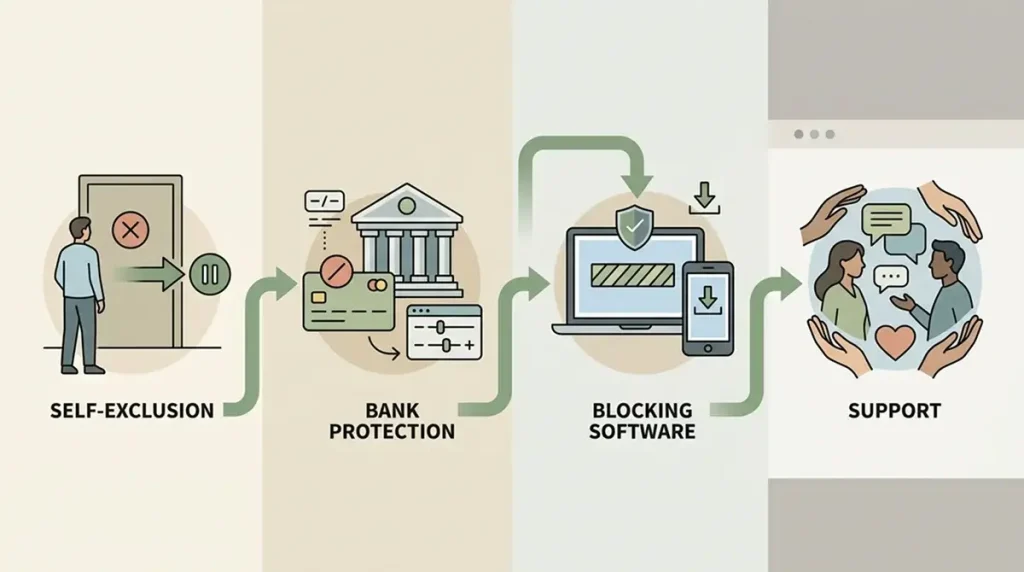
If you are self-excluded and searching for gambling sites outside that protection, the most important issue is not whether another website exists. The more useful question is what would help you stay protected during the moment when the urge feels strong. Self-exclusion is meant to create space between you and online gambling. Looking for a way back in can be a sign that extra support is needed, not a sign that you have failed.
GAMSTOP explains that an exclusion cannot be removed during the minimum period. That minimum period is part of the protection. It is not something to solve with a different website, a different payment route or a different account. A better next step is to add layers: blocking tools, bank gambling blocks, practical support and, where helpful, trusted people who can help you slow the decision down.
Immediate Steps to Manage UK Casino Self-Exclusion
When the urge is active, a long list of options can be overwhelming. Reduce the decision to one practical action that makes gambling harder right now. Close the gambling page. Move away from the device. Tell someone you trust that the urge is present. Put a short delay between the urge and any money transfer. The aim is not to win an argument with yourself; it is to create enough space for the urge to lose some force.
It can also help to remove the idea that you must solve everything at once. A difficult gambling urge often rises and falls. A delay, a conversation, a bank block, or a support chat can be enough to break the chain between searching, registering, depositing and chasing losses.
- If you have a gambling page open, close it before reading further.
- If a card or wallet is in reach, put it somewhere less immediate.
- If you trust someone nearby, say plainly that you are feeling pulled toward gambling.
- If you are alone, use a support service or blocking tool rather than another gambling page.
Recommended online casinos
- BeOnBetBonus: 100% up to €500 + 100 FS · Payout speed: 1-3 business days
- WinBeastBonus: €5000 + 500 FS + €650 Freebet · Payout speed: 1-3 business days
- BritsinoBonus: Welcome Package – Get your £2,200 + 2,000 FS · Payout speed: 1-3 business days
- AmunbetBonus: Join now and get 450% up to 2,700 GBP + 450 FS · Payout speed: 1-3 business days
- x3betBonus: Welcome Pack 100% Up to £1.000 + 200 Free Spins · Payout speed: 1-3 business days
- NightLuckBonus: Welcome Pack + 805% Up To 6400€ + 280 FS · Payout speed: 1-3 business days
A decision path for common situations
| What is happening | Useful next step | What to avoid |
|---|---|---|
| I am self-excluded but want to gamble again. | Keep the exclusion in place and add another layer such as a bank gambling block or blocking software. | Do not look for a site outside the scheme as an alternative route. |
| I feel close to depositing. | Create a delay, remove easy payment access and contact support before any transfer. | Do not test a small deposit to see what happens. |
| I have already deposited and regret it. | Keep records, stop further deposits and consider speaking to support or your bank if a block is needed. | Do not chase losses or increase stakes to recover money. |
| I am worried about debt or control. | Use specialist gambling support and consider financial guidance from appropriate advice services. | Do not hide the problem until pressure becomes unmanageable. |
Layered protection is stronger than one tool
GambleAware describes gambling blocking and self-exclusion as a layered approach that can include GAMSTOP, blocking software, bank blocks and venue self-exclusion. That matters because no single tool covers every situation. Online self-exclusion can reduce access to participating online companies, while bank gambling blocks can reduce the ease of gambling transactions through participating banks. Blocking software can help limit access on devices, and venue exclusions can address in-person gambling.
These layers are not perfect and should not be described as guarantees. Some banks offer gambling transaction blocks, and the features can differ, including possible cooling-off periods before a block can be removed. The practical value is that each layer adds friction. When an urge is strong, friction is useful because it creates time for a different decision.
- Keep self-exclusion active. Do not treat the minimum period as something to work around.
- Ask your bank about gambling blocks. Check how the feature works and whether a delay applies before it can be switched off.
- Consider blocking software. Device-level blocking can reduce exposure to gambling pages and adverts.
- Reduce payment immediacy. Make it harder to move money quickly during an urge.
- Use human support. A conversation can interrupt secrecy and reduce the pressure to act alone.
Support you can contact
GamCare lists the National Gambling Helpline as 0808 8020 133 and describes support as available at any time of day, with online contact options as well. This kind of support can be useful before a deposit happens, after a loss, or when the main problem is the fear that gambling is becoming hard to control.
You do not need to wait until the situation is extreme. If you are repeatedly searching for ways to gamble despite self-exclusion, that is enough reason to speak to someone. A support conversation can help you decide what to block, what to tell a trusted person, and what to do about money pressure without giving you another gambling option.
If there is an immediate risk to your safety or someone else’s safety, use emergency help in the place where you are. Gambling support services are important, but they are not a substitute for emergency response when urgent safety is at risk.
How to talk about it without shame
Many people delay getting help because they feel embarrassed. Shame can make the urge worse because it pushes the problem into secrecy. A plain sentence is often enough to begin: “I am self-excluded and I am feeling pulled back to gambling.” That sentence does not require a diagnosis, a perfect explanation or a promise that everything will be fixed immediately.
If you are speaking to a friend, partner or family member, ask for a concrete action rather than a general lecture. You might ask them to sit with you while you close accounts, help you contact support, hold a card temporarily, or check in during the times when gambling urges usually appear. The aim is practical support, not judgement.
What not to do when the urge is strong
- Do not treat a site outside GAMSTOP coverage as a safer replacement.
- Do not create new accounts to test whether blocks still work.
- Do not use a different payment route to get around a bank gambling block.
- Do not chase losses after a deposit you already regret.
- Do not send identity documents to a site whose licence and privacy information you cannot verify.
- Do not stay alone with the urge if support is available.
If you already used a gambling site
Stop the next deposit first. Then keep a record of the account, the transaction, the terms you saw, and any messages from the site. If your concern is a blocked withdrawal or unclear account restriction, the page on complaints and money protection can help you organise the facts. If the concern is that gambling access has restarted despite self-exclusion, focus on adding protection rather than arguing with the site while the urge continues.
Bank blocks may be especially useful after a relapse because they reduce the chance of quick repeat deposits. The dedicated page on bank blocks and gambling payments explains that money-control question separately. The page on ID checks and limits explains why account checks and limits should not be treated as obstacles to dodge.
Short questions
Can I cancel GAMSTOP during the minimum period?
GAMSTOP says the exclusion cannot be removed during the minimum period. Treat that as a protection boundary and add support around it if the urge to gamble returns.Are bank gambling blocks guaranteed to stop every payment?
No. Features differ between banks and payment routes. They are useful protective layers, not guarantees. Ask your bank how its block works and whether a cooling-off period applies.Is it too early to contact support?
No. Wanting to gamble despite self-exclusion is enough reason to talk to a support service or someone you trust. You do not need to wait for a larger loss.